Solar Screen FAQs . . .
Q: IS THERE A RIGHT AND WRONG WAY TO INSTALL SOLAR SCREENS?
A: Recently we have viewed several homes on which a certain company
in Colorado has been installing solar screens. There is a right and
wrong way to install solar screens. This certain company is
installing solar screens by replacing the bug screen on the window
with solar screen and making another screen for the non-opening
side of the window where they attach this screen by placing screws
into the actual window frame. An application, while it looks fine,
that has many issues: (1) the screen they use (New York Wire) is a
terrible screen and will fail within a few years, (2) making a hole
into the actual window frame not only cancels any warranty that
window might have, but also creates a path for temperature to pass
into the home, (3) the screens are made with plastic corners which will crack, (4) there is no insulating factor placed between the screen and window thereby allowing temperatures to pass from the screen to the window and into the home, (5) placing a screw into the window frame has the possibility of cracking the window, and (6) installing solar screens this way are not in accordance with U.S. Dept. of Energy's recommendations.
Q: HOW DO SOLAR SCREENS KEEP THE HEAT OUT?
A: Unlike fiberglass screens, Phifer Suntex solar screens are made of a polyester vinyl coated screen material designed to absorb and deflect the heat before entering your home.
Q: WHAT CAN I WHAT CAN I EXPECT IN ENERGY SAVINGS?
A: Previous customers have reported a 25-45 percent savings on their energy bill.
Q: HOW DO SOLAR SCREENS EFFECT THE NATURAL LIGHTING AND TEMPERATURE OF MY HOME?
A: There are two variations of the Solar Screens.
1. 80% grade - Darkens up to 25% and cools up to 34 degrees.
2. 90% grade - Darkens up to 40% and cools up to 38 degrees.
Q: WHAT IS THE INSTALLATION TIME TO GET SOLAR SCREENS ON MY HOME/BUSINESS?
A: From the date of purchase, solar screens can usually be installed within 2-5 weeks (depending on the season and the amount of jobs in manufacturing). Most applications take 2-3 hours of on-sight installation time.
Q: SOLAR SCREENS VS. WINDOW TINT ON GLASS?
A: Solar Screens exterior applications prevent the contact of solar radiation and UV rays from contacting the glass. Glass tinting is an interior application that filters the light but leaves your glass exposed to the heat.

View of a Window with Window Tint from Outside
Q: WILL SOLAR SCREENS PROTECT MY HOME INTERIOR FROM FADING?
A: Solar Screens block up to 90 percent of the UV Rays and heat from fading drapery, furniture and upholstery that bares the direct abuse of heat and sun rays.
Q: WHAT MAKES US DIFFERENT FROM OTHER COMPANIES?
A: The biggest difference between solar screens is not only the screen material but the frame construction. We use some of the strongest frame material available which is 1" wide x 7/16 frame, whereas inexperienced companies will use a 3/4" wide x 5/16 frame which can cause the screen to sag, bow, bag and/or become loose over time.
How your screens are installed is also an important part of the longevity of your solar screens and windows. Our expert installers will examine your windows to find the correct placement of screws and clips, if needed. This is done so that you as the homeowner will be able to remove and install the screens with ease.
Q: SHOULD I CHOOSE 80% OR 90% SOLAR SCREENS?
A: There are a few reasons, the most common is to allow more sunlight to illuminate the room while still having some protection. Common applications for Suntex 80 are windows where the sun exposure is minimal, or on any room where maximum natural light is preferred.
Q: WILL SUNTEX 90% BLOCK TOO MUCH LIGHT, MAKING MY ROOMS TOO DARK?
A: Suntex 90 does make a noticeable change in the lighting of your rooms. It's a natural tradeoff, blocking most of the sun's heat does require a reduction in the amount of light coming in. In the end it is a personal choice and only you can say how much light is needed in your home. It may help to consider which concerns you more: having too much heat, -or- having too much shade. Look at this picture, the straight-ahead daylight view is actually better than the old 70% sun screens (but the room will be darker). If you are trying see out at an extreme angle to the window then your view will be blocked, it's the same properties that block more of the sun as the angle gets sharper.
Q: WHAT ABOUT LOW-E WINDOWS. DO I NEED SOLAR SCREENS?
A: There are two factors to consider in energy efficient low-E windows. The first is the insulating or R-value, which is the ability to stop thermal energy (cool or warm air) from passing through. The second is the Shading Coefficient (SC), or the ability of solar energy to pass through. In our climate a low SC is desired (yes, it's backwards - a low SC means greater shading ability). Some low-E windows have achieved an SC of .35, which is comparable to a shading efficiency of about 10%. Solar screens do remain as the most effective at rejecting solar energy, but the choice is a personal one. The lowest possible cooling bills would be achieved with the lowest SC value (Suntex 90 has an SC of approximately .07).
Q: HOW DO I KEEP MY SOLAR SCREENS CLEAN?
A: If they are just dusty a light rinsing with a hose should easily take the dust off. When dirt becomes "baked" on the screen they are a little harder to clean. A soft window scrubber and some mild detergent should do the trick. Be sure to rinse well to remove all the detergent. Also take care not to stretch the screen out of shape.
Q: DO SOLAR SCREENS AFFECT MY WINDOW WARRANTY?
A: No. Our Solar Screens are attached over the window, not to the window. Tint or films applied to the glass often void the warranty. The window warranty will not cover attachments to the window (it doesn't need to, the screens have their own warranty). Read your own window warranty and I think you will find it is reasonable and aligned with common sense logic. Properly installed screens do not interfere in any way with the function or integrity of the window, and should not adversely affect the window warranty.
Q: ARE EXTERIOR SHADES MORE EFFICIENT THAN INTERIOR SHADES OR LOW-E WINDOWS?
A: YES, without question. This is an answer highlighted by the U.S. Dept. of Energy ... "interior shading is not as effective as exterior shading". Windows and shading devices are rated by their Solar Heat Gain Coefficient (SHGC), previously known as Shading Coeficiency (SC), ... the lower value represents the least amount of solar gain.
(source: http://www.enviroshutters.co/file/Dept._Of_Energy_s_leaflet__Highlighted_areas_regarding_
Solar_Screens_and_Rolling_Shutters.pdf)
LOW-E WINDOWS. Depending upon various factors, Low-E Windows offer a Solar Heat Gain Coefficient ratings of anywhere between .33 to .71.
(source: http://wiki.naturalfrequency.com/wiki/Shading_Coefficient)
INTERIOR SHADES. Statistics for Hunter Douglas' BEST interior shade ... the Duette honeycomb shade, shows the Duette shade Solar Heat Gain Coefficient ratings ranging between .15 to .63.
(source: http://www.blindalley.com/portfolios/hunterdouglas/portfolioslarge/duetteenergyefficiency.html#Energy)
WINDOW TINT. As a whole Window Tint offers a Solar Heat Gain Coefficient ratings of anywhere between .40 to .98.
(source: http://www.ppg.com/corporate/ideascapes/resglass/homeowners/product/Pages/ProdInfoSolarControl.aspx
Now compare those numbers to Exterior Shading Products, such as solar Solar Screens. The Phifer Suntex Heavy Duty Solar Screen shows a Solar Heat Gain Coefficient rating of between .15 to .07 for Suntex 80, and .08 to .07 for Suntex 90. CLICK HERE TO VIEW THE PHIFER SUNTEX SPECIFICATIONS SHEET.
Q: HOW DO WINDOW AND TINT COMPANIES CLAIM BETTER UV PROTECTION THAN OTHER WINDOW
HEAT REDUCTION PRODUCTS?
A: The trick to this sales technique are the words "UV Protection". Most if not all window and window tint manufacturers and distributors use this misleading terminology. First, window tint does not provide better "UV Protection", it just simply provides UV Protection and that's it, very much comparable to other like products. Second, the trick is that UV Protection doesn't COOL your home/business, it simply yields fading of items within your home. Third, the Solar Energy that enters your home or business is made up of several types Electromagnetic Radiants, such as microwaves, infrared radiation, visible light, gamma rays, ultraviolet radiation (UV-Rays), and x-rays.
UV-Rays only make up 4% of this total energy from the Sun. Therefore, when a salesman approaches a customer and states that his/her window or tint reduces 70% - 90% of "UV-Rays", essentially they are telling you that they can reduce the Sun's energy entering your home by 3% - 4%. Additionally, while window tint has a long history of disappointed customers, it can also void window warranties and crack windows panes.
WHEREAS, a solar screen reduces the SUN's TOTAL ENERGY by 80% to 90% does not affect the window warranties and has never cracked a window, actually to the contrary it protects windows from the sun's damaging effects.
Q: CAN THE SUN'S REFLECTION OFF MY WINDOWS BURN MY GRASS AND BUSHES?
A: Most definitely!! We have customers contact us all the time about their windows (especially Low-E windows) burning their grass and bushes. We have even had customers contact us with the same problems melting their artificial grass. The sun's reflection off windows is very powerful. For example, the melting point of artificial grass is about 245 degrees.
Q: WHEN IS A WARRANTY AN ACTUAL WARRANTY IN COLORADO?
A: Some manufacturers claim to have a "LIFETIME WARRANTY". In Colorado a "lifetime warranty" can mean whatever the seller wants it to mean, according to the Colorado Attorney General's Office; however, the Federal Trade Commission states that a warranty MUST state the EXACT number of years. We have had calls about a certain solar screen manufacturer claiming "lifetime warranty". This material is not as good of quality as the material we use in our solar screen manufacturing process. OUR SOLAR SCREEN MATERIAL HAS AN ACTUAL 10 YEAR WARRANTY and OUR ROLLING SHUTTERS HAVE A 3 YEAR WARRANTY ... NO TRICKS NO GIMMCKS!
Q: CAN WINDOW TINT CRACK MY WINDOWS?
A: Yes they sure can. There are many downfalls to window tint
which unfortunately window tint companies neglect to tell their
customers. That's why I call these people "Window Tint Victims".
Window tint companies have many "excuses" why window cracking
occurs after tint has been applied. The simple fact is this ... window
tint heats up the window to the point of cracking, but it's not just
window tint. Those reflective window shades similar to what we
place in cars also crack windows .. yes it can crack your car window
as well.
How does it heat up your window? Window tint is made up of
tiny metallic flakes. Metal of course is a heat conductor. So as the
metal flakes heat up on your window, it will in turn heat up your
window as well.
Q: SHOULD I LEAVE MY SOLAR SCREENS ON DURING THE WINTER?
A:  This is a customer's preference. However, solar screens do provide some insulation for your windows and we do recommend that a customer try the solar screens n the windows for one winter and compare the difference.
This is a customer's preference. However, solar screens do provide some insulation for your windows and we do recommend that a customer try the solar screens n the windows for one winter and compare the difference. During the winter, the sun is at about 30 degrees on the horizon in Colorado. This actually provides more passive solar to pass through the solar screen to reach the window, but it also allows the solar screen to insulate the window against the cold temperatures ... keeping the cold winds off the glass much like a storm door. Additionally, there are less daytime hours in the winter season, it is also usually more overcast, limiting your chances of passive solar heating. Solar screens also create a barrier for thermal equilibrium keeping the temperature of the glass warmer. The warmer you keep the glass, the less convection heat you need to use in your house, conserving energy.
See the images below ... these windows/doors have single-pane glass. One has a solar screen over the window which shows a 4.5 degree warmer temperature during the winter than the picture of the window without solar screen. These were taken within minutes of each other ....
View of the same Window with Window Tint from Inside
This is a Las Vegas window with Window Tint. It creates a reflective surface from the Outside, but does nothing to prevent the heat from reaching indoors ... at a 116 degrees!

google-site-verification: google672afe82b8fdf89f.html


SEE WHAT OUR CUSTOMERS SAY ABOUT US!!
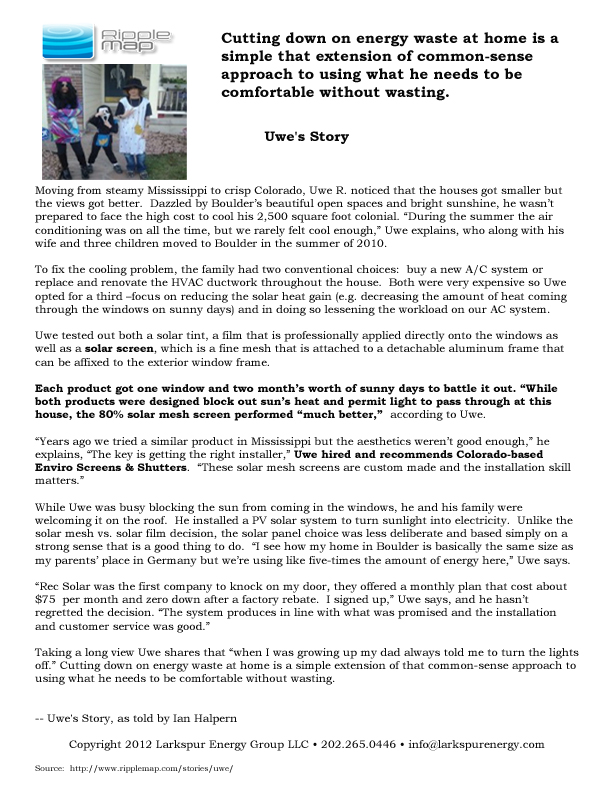
CLICK ON THE PRESS RELEASE TO SEE AN ARTICLE FROM ONE OF OUR CUSTOMERS....
ALSO, SEE SOME
OF OUR
CUSTOMER VIDEO TESTIMONIALS ...
(click the enlarge button)
















We are Proud Distributors of the following products in
Colorado and Nevada ...


Check out the links below for information about solar "mesh" screens












© 2013 Enviro Screens and Shutters, Inc. All rights reserved. Website Designed/Marketed by:

Our Links: Follow Us: About Us:
Enviro Screens and Shutters, Inc. and Enviro Shades Manufacturing, Inc., specialize in security shutters, rolling shutters, rolling shades, and solar screens for residential and commercial Colorado and Nevada customers. We are family owned and operated with over 36 years of Colorado and Nevada quality customer care. We can handle any size residential and commercial job. For more information and a free estimate, call Enviro Screens and Shutters at 303-794-2072 or 800-221-4613. (read more)